



BLOWING IS NOT ENOUGH TO ELIMINATE NOISE PROBLEMS
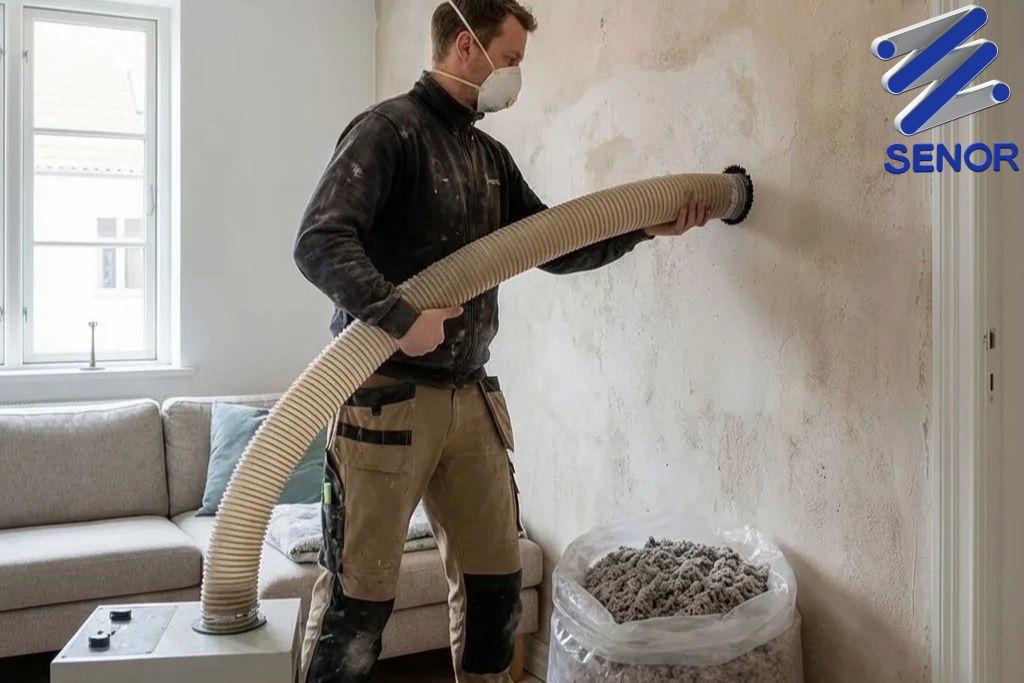
Blown-in insulation has become one of the most requested solutions for improving residential comfort. It’s a quick process that doesn’t require major construction and is effective for thermal insulation.
However, when it comes to acoustic insulation, it isn’t enough.
Many people who experience noise issues choose to have their walls insulated this way, convinced it will solve their problems. In reality, this technique is insufficient for eliminating noise issues.
🎯 What is Blown-in Insulation?
Blown-in insulation involves filling a wall’s air cavity with insulating materials, typically through the injection of:
- Mineral wool (glass or rock)
- Cellulose
- Granulated cork
- Polyurethane foams or other expansive products
Its primary function is to improve a building’s thermal insulation, reducing heat loss in the winter and preventing heat from entering in the summer.
🚧 Limitations of blown insulation in acoustics.
When it comes to noise, blown-in insulation doesn’t provide the expected results:
- ❌ It doesn’t eliminate impact noise, such as footsteps, furniture dragging, or bumps.
- ❌ It doesn’t correct structural transmission through slabs, beams, columns, or walls.
- ❌ It only provides a slight attenuation of airborne noise (conversations, traffic, television).
- ⚠️ It can create a false sense of security, delaying the search for a real solution.
👉 To summarize:
- Blown-in insulation = thermal insulation YES
- Blown-in insulation = acoustic insulation NO
🎯 What’s Needed for Effective Acoustic Insulation?
Achieving acoustic comfort isn’t about using a single product; it requires a complete construction system. This system combines several elements:
- ✅ Acoustic isolators: These devices block the transmission of vibrations and structural noise.
- ✅ Elastic strips and acoustic pads: These are used to decouple floors, walls, and ceilings, preventing rigid contact points that would otherwise transmit sound.
- ✅ Mineral wool: This material acts as an absorbent layer within the system.
- ✅ Plasterboard or panels: These add mass to block sound transmission.
- ✅ Acoustic membranes: These provide additional mass and acoustic impedance, which improves insulation.
Acoustic impedance: is the resistance a material offers to the passage of sound. The greater the difference in impedance between two materials, the harder it is for noise to transmit through them. Since acoustic membranes are dense and flexible, they create a “barrier” that causes sound to lose energy as it tries to pass through.
- ✅ Profiles (metal or wood frames): These provide rigidity to the system.
- ✅ Air gap: A thicker space between layers results in greater insulation.
- ✅ Correct installation: The system must be executed without cracks or rigid contact points.

💡 Practical Example
A homeowner in an apartment building decides to blow mineral wool into all the exterior walls of their unit (which have an air cavity) because they are bothered by traffic and neighbour noise.
The result: The noise doesn’t go away.
The reason is that their home is affected by both airborne and impact noise. The real solution would have been a proper acoustic insulation system for the walls, not just a simple blown-in treatment.
🛠️ Comparative table
| Solution | Thermal insulation | Airbone noise | Impact noise | Structural transmision |
| Blown-in insulation | ✅ Yes | ⚠️ Limited | ❌ No | ❌ No |
| Complet acoustic system | ✅ Yes | ✅ Yes | ✅ Yes | ✅ Yes |
📌 The Importance of a good previous diagnosis
Before you start any intervention, it’s essential to consider several key aspects:
- ✅ Being well-informed and advised is crucial for doing what you really need to, not just what “seems” like it might help.
- ✅ Understanding the limitations and advantages of each system prevents unnecessary costs or investments that don’t solve the root problem.
- ✅ Identifying the type of noise is essential. Airborne noise (conversations, traffic, music) is not the same as impact noise (footsteps, knocks, vibrations). Each type is transmitted through different paths and requires specific solutions.
- ✅ Designing systems that address both types of noise. Sometimes there is a false perception that only airborne noise affects us, but this also induces vibrations that turn into impact noise.
- ✅ Checking your home’s weak points: old windows, cracks, poorly fitted doors, shutter boxes, ventilation shafts, plaster or drywall ceilings without insulation… all of these multiply the entry or transmission of noise if not treated correctly.
👉 In short, a good initial diagnosis is the basis for designing the most effective solution and avoiding frustration.
🧭 Conclusion
Insulation blowing is a good technique for improving energy efficiency, but it does not solve noise problems.
If what you are looking for is peace and acoustic comfort in your home, you need a complete acoustic system, designed with specific products and executed in a professional manner.
👉 At SENOR, we advise you on finding the most effective solution for every acoustic problem.
📧 tecnico@senor.es | 📞 607 411 620