



A PRACTICAL GUIDE TO CHOOSING A GOOD ACOUSTIC ABSORBING MATERIAL
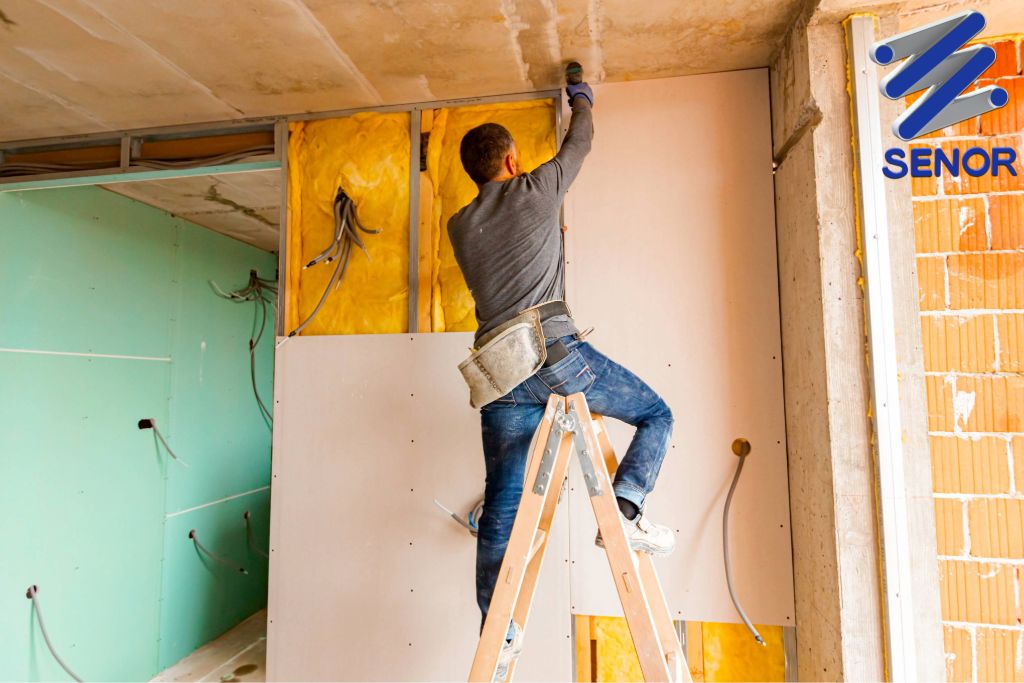
(…and make a key decision for the performance of the system)
At SENOR we do not manufacture absorbent materials. Our speciality is acoustic dampers, acoustic bands and anti-vibration systems.
However, we are well aware that the performance of any acoustic building system depends on many factors, and one of them – often overlooked – is the quality of the absorbing material.
Many of our customers – whether they are installers, distributors or technicians – often ask us what type of absorbent material they should place inside their ceilings, wall linings, partitions or floors to complete the acoustic solution.
That is why we wanted to prepare this small guide, with a technical and constructive approach, to help make better decisions based on objective criteria and real experience on site.
We hope it will serve as useful guidance for those seeking to improve the acoustic comfort of spaces with effective, coherent and well-thought-out solutions from the beginning.
🎯 1. Acoustic absorption coefficient (α)
This measures the material’s ability to absorb sound, on a scale from 0 (zero) to 1 (maximum).
- 📌 📌Recommended range: α ≥ 0,70 (in thicknesses of 40 to 50 mm)
- ⭐ Optimal value: α ≥ 0,90
If a material offers these values with a thickness of only 4 or 5 cm, it is a very efficient product. Remember that not all materials that ‘look’ acoustic are actually acoustic.
💨 2. Air flow resistance (AFr10)
This value is key and often overlooked. It indicates how much resistance the material offers to the passage of air (and therefore to the passage of sound). If the air passes through too quickly, no energy is dissipated. If it fails to penetrate, sound is reflected.
- 📌 📌 Recommended range: between 5 and 15 kPa·s/m²
- ⭐ Optimal value: 10 kPa·s/m²
An absorber with AFr10 within this range allows sound to penetrate, dissipate within the material and not bounce back. If this value does not appear in the data sheet, be cautious.
⚖️ 3. Density of the material
This is one of the most misunderstood facts. Many people think that the denser the better… and this is true. If it is too compact, it starts to behave like a barrier. So if a material is too light, it doesn’t absorb well.
- 📌 Recommended density: 30 kg/m³
- 🔎 Acceptable range: entre 30 y 70 kg/m³
- ⚠️ Avoid materials below 20 kg/m³ or above 80-90 kg/m³
A density of 30 kg/m³ provides the perfect balance between lightness, porosity and acoustic efficiency, especially in plasterboard systems.
🔥 4. Reaction to fire
This point is not in dispute. In ceilings, wall linings, partitions or floors in houses, hotels, offices or public buildings, the material must comply with the requirements of the CTE.
- 📌 Minimum requirement: Euroclase A2-s1,d0
- ⭐ Optimum value: A1
A good absorber must be non-combustible, not generate smoke or flaming droplets in case of fire. And it must be clearly certified.
🌡️ 5. Thermal conductivity (λ)
It is becoming increasingly common to combine acoustic and thermal insulation in the same solution. It is therefore of interest that the absorber has a good thermal resistance.
- 📌 Recommended range: λ ≤ 0,035 W/m·K
- ⭐ Optimal value: λ = 0,032 W/m·K
This improves indoor thermal comfort, reduces energy loss and optimises building systems.
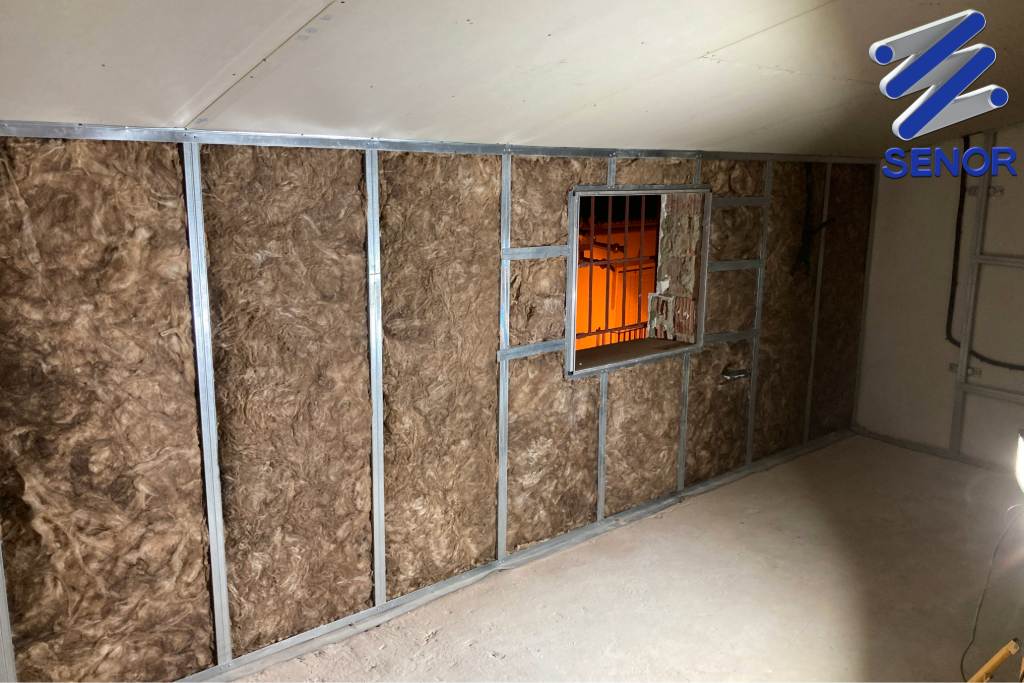
💡 Extra tip: want to improve even more?
If the system allows it (due to space or design), an excellent way to improve both acoustic and thermal insulation is to place a double layer of absorbent material: for example, two layers of 50 mm mineral wool.
This solution not only improves absorption over a wider range of frequencies, but also reinforces the thermal resistance of the whole, providing much more effective overall comfort.
Provided that the thickness allows it, installing double absorbent material is a simple, economical and very effective decision.
And something even more important:
It is absolutely esential to use the absorbent material at all times, even in solutions that are not specifically designed as acoustic systems.
Whether it is a false ceiling, a technical partition wall or an air gap, the absorbent material makes the difference between a functional system and an ineffective system.
⚠️ Watch out for “trendy” materials
In recent years, products such as certain polyurethane agglomerated foams have gained popularity due to their professional image, ease of installation and powerful marketing campaigns.
However, many of these materials have excessive densities or inadequate airflow resistances, compromising their performance as real absorbers.
And while they may be useful in certain contexts, there are much more balanced and effective options for ceilings, wall linings, partitions and floors.
As always, it’s not about looks, it’s about proven technical data.
💰 Quality-price ratio: rigour without obsession
It is not always necessary to use the most advanced or the most expensive equipment. What is important is that it fulfils the essential technical criteria, is well documented and has a balanced performance.
- ✔ Be rigorous, but not obsessive.
- ✔ There is no need to strive for perfection.
- ❌ Avoid products without technical data sheets or with ‘magical’ properties.
A well-designed system does not need extreme products, but components that are compatible with each other and well executed.
⛔ The absorber does NOT eliminate vibrations
This point is fundamental and should be remembered:
The absorbing material does not decouple or dampen. Its function is acoustic, not anti-vibration.
And yet, it is common to find systems – especially in floors – where only an absorbent wool or foam is placed, without dampers or elastic bands.
This may give a false sense of isolation, but vibrations are still transmitted to the structure, as the absorbing materials are manufactured for a different purpose.
The result: impact noise, structural propagation and a system that does not fulfil its purpose.
✅ How to make the right choice?
Here is a clear summary of the values we recommend:
| Property | Recommended Range | Optimal Value |
| Absorption coefficient (α) | ≥ 0,70 | ≥ 0,90 |
| Flow resistance (AFr10) | 5 – 15 kPa·s/m² | 10 kPa·s/m² |
| Density | 30 – 70 kg/m³ | 30 kg/m³ |
| Fire reaction | A1 o A2 | A1 |
| Thermal conductivity (λ) | ≤ 0,035 W/m·K | 0,032 W/m·K |
🤝 Sincere advice from SENOR
Although we don’t manufacture absorbent materials, we do care about how our products are used.
And we know that when a customer uses SENOR dampers but chooses the wrong absorbent material, the system loses efficiency and the result is not up to the expected standard.
That’s why we wanted to share this guide. To help you choose well, with technical criteria, with common sense, and always thinking about the quality of the whole.
Because acoustic insulation does not depend on a single layer.
It works when all the elements are well chosen, well installed and well-coordinated.
📩 Do you have any doubts about which material to use?
If you have any doubts about which absorbent to choose, we recommend that you contact the Technical Department of the material manufacturer directly.
They will be able to guide you on the suitability of the product for each specific application.
And remember:
Before purchasing any absorbent material, consult its technical data sheet and verify the information we have analysed in this guide.
A good system starts with a good choice.
If you require technical assistance or additional information, please do not hesitate to contact our Technical Department. We will be delighted to answer all your queries:
Technical Department
tecnico@senor.es
607 411 620